Editorial intelligence only. Not legal, tax, or investment advice. IRS worldwide income reporting obligations apply to all US citizens regardless of where they own property or reside.
Phuket and Bali are the two Southeast Asian resort markets every American buyer asks about. Both offer extraordinary natural environments, established short-term rental demand, and entry prices well below comparable resort markets in the Caribbean or Mediterranean. One of them allows Americans to own freehold property in their own name. The other does not — anywhere in the country, by law. This is the comparison that matters most, and it is consistently underplayed by agents active in the Bali market.
| Factor | Phuket, Thailand | Bali, Indonesia |
|---|---|---|
| Foreign freehold ownership | Yes — condos (not land) | No — leasehold only |
| Maximum leasehold tenure | 30 yr + 30 yr renewal (land) | 25 yr + 25 yr (max 50–55 yr) |
| Long-term residency via property | LTR Visa — 10 yr from $500K | No property-linked residency |
| Acquisition costs | 3–5% (transfer fee + agent) | 5–10% (lease costs + notary + agent) |
| Gross rental yield | 5–8% (managed condos) | 8–15% (headline; net varies widely) |
| Currency | THB (floating vs USD) | IDR (floating vs USD) |
| Safe Haven Criteria (10 pts each) | Phuket | Bali |
|---|---|---|
| Geopolitical stability | 7 | 7 |
| Rule of law / title security | 8 | 4 |
| Tax environment | 8 | 7 |
| Residency access | 8 | 5 |
| Banking & capital access | 8 | 6 |
| Safe Haven Score (50 pts) | 39 | 29 |
The Ownership Structure Problem in Bali
Bali's property market is one of the most actively marketed to Western buyers in Asia. The lifestyle proposition is compelling — rice field villas, year-round warmth, a creative and spiritual culture, and an established international community in Canggu, Seminyak, and Ubud. The problem is structural and legal: Indonesia prohibits foreigners from holding Hak Milik (freehold title) on any land or property anywhere in the country. This is national law, not a Bali-specific rule, and there is no exception pathway.
Foreigners buying in Bali use one of three structures: (1) a leasehold agreement (Hak Sewa) for 25 years with one renewal option, giving a maximum effective tenure of approximately 50 to 55 years including registration time; (2) a nominee structure where an Indonesian citizen nominally holds the freehold on behalf of the foreign buyer — this arrangement is legally invalid under Indonesian law, is not enforceable in Indonesian courts, and exposes the buyer to complete loss of the asset if the nominee relationship breaks down; or (3) a foreign-owned company (PT PMA) structure that can hold a "Right to Build" (HGB) title for up to 80 years across renewals, at significant additional administrative cost and ongoing compliance burden. None of these equates to freehold ownership. An American with 50 years of remaining leasehold at age 40 holds a wasting asset that will require renewal negotiation or relinquishment before they turn 90.
Bali's headline rental yields of 8% to 15% must be evaluated against this structural reality. A leasehold property that cannot be inherited in freehold, resold with the same lease remaining, or expanded beyond the terms of the original lease agreement is not comparable to a freehold asset producing 5% to 8% in Phuket. The net present value of a 25-year leasehold at 12% yield is meaningfully lower than a freehold at 6% yield when the terminal value calculation is honest.
Phuket: What Freehold Condo Ownership Actually Means
Thailand's Condominium Act (1979, amended multiple times) permits foreigners to hold freehold ownership of individual condo units provided the building maintains less than 49% foreign quota ownership. This is genuine title — registered at the Land Department, fully transferable, inheritable, and mortgageable (though Thai mortgages are unavailable to non-residents; US banks do not lend against Thai property). The unit can be sold to any buyer (Thai or foreign) in a normal real estate transaction with Land Department registration.
The limitation: this freehold right applies only to condo units, not to land. An American buying a villa in Phuket — a pool villa on its own land parcel — cannot own the land freehold. Villa buyers use land lease structures (30 years + 30-year renewal option) or Thai company structures. For buyers wanting the cleanest ownership structure in Phuket, condominiums in the 49% foreign quota are the defensible choice.
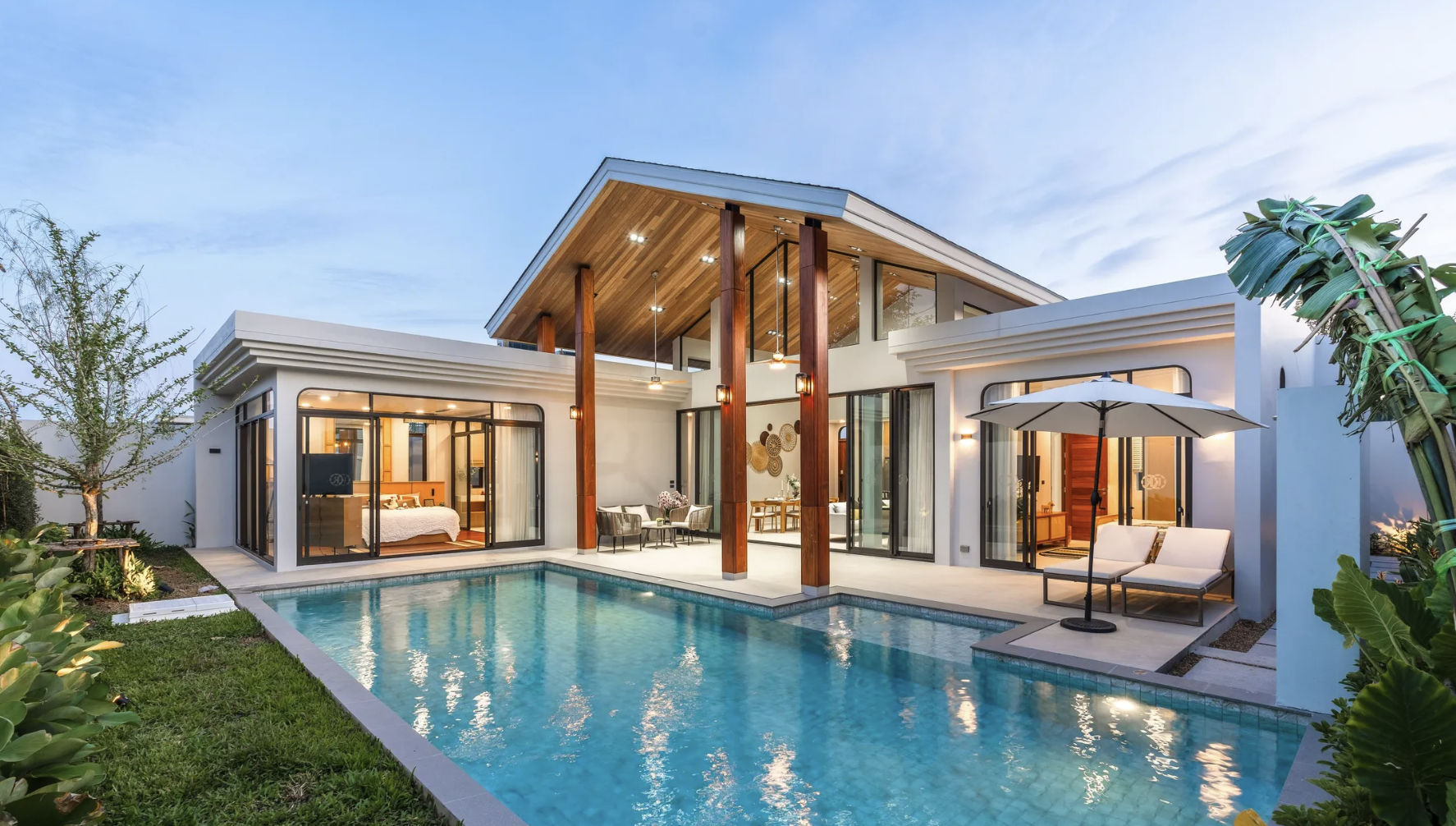
Phuket's condo market in 2026 spans a significant range. Entry-level condos in Patong, Kathu, and eastern Phuket start from approximately THB 2.5 million (USD 70,000). Sea-view units in Kamala, Surin, and Cape Yamu — the premium west coast locations — run from THB 8 million to THB 40 million (USD 220,000 to USD 1.1 million). The villa in the hero photo above — a 3-bedroom pool villa in Thalang — was priced at $533,388 at time of listing. Managed rental programmes with established hotel operators (Anantara, Outrigger, COMO) provide turnkey income management and average 5% to 7% gross yields on participating units.
For condo zone analysis, LTR Visa qualification logistics, and managed rental operator comparisons specific to American buyers in Phuket.
Visit PhuketForAmericans.com →The LTR Visa: Thailand's 10-Year Residency for Americans
Thailand's Long-Term Resident Visa, launched in September 2022 and administered by the Board of Investment, is a 10-year renewable visa providing genuine long-term legal status for high-net-worth Americans. The Wealthy Global Citizen category — the most relevant for property buyers — requires: assets of at least USD 1 million; either an annual income of at least USD 80,000 for the past two years, or USD 500,000 invested in Thai government bonds, Thai real estate, or a BOI-approved fund. A Phuket condo purchase of USD 500,000 qualifies as the real estate investment component.
The LTR Visa provides: 10-year duration (two 5-year stamps); 90-day reporting exemption (standard Thai visas require 90-day police reporting); multiple entry with no re-entry permit; and a work permit for those intending to work remotely in Thailand for non-Thai employers. The visa does not require annual stays or trips to maintain. For Americans who want to spend 2 to 5 months per year in Phuket, the LTR Visa eliminates the visa-run complexity that makes standard Thai residency administratively burdensome.
Evaluating Phuket vs Bali — or Southeast Asia against the Gulf or Europe? Peter Tumbas works with American buyers on cross-market positioning and US-side context. Initial consultations are complimentary.
Peter Tumbas, REALTOR® · Berkshire Hathaway HomeServices New England Properties · CT License RES.0836133

Peter Tumbas advises American buyers evaluating international property markets across Europe, the Gulf, Southeast Asia, and the Caribbean. He founded the Safe Havens for Americans platform to provide independent, non-promotional intelligence on the markets and processes Americans encounter when purchasing property abroad.