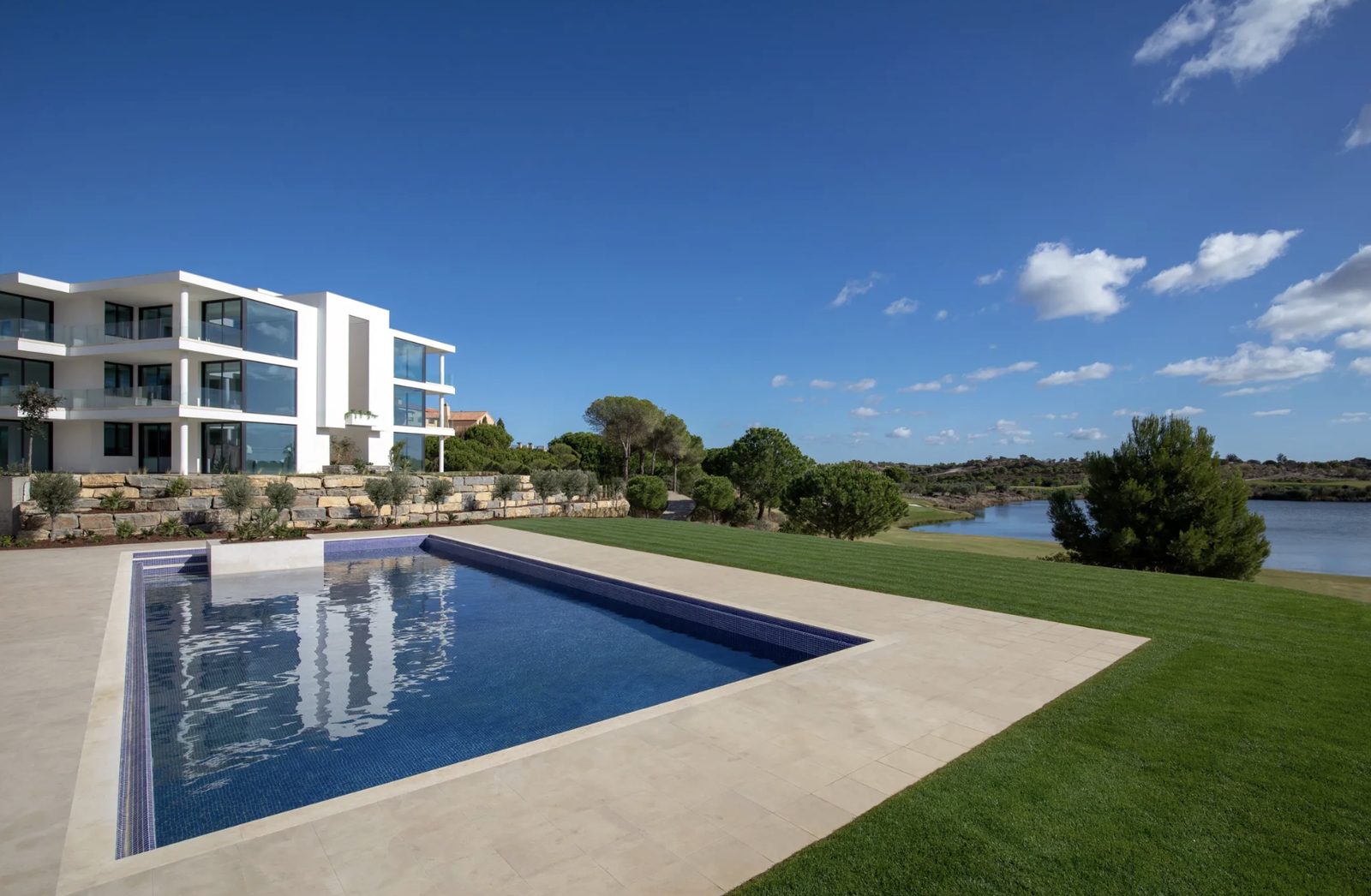
A Monte Rei Country Club furnished 2 bedroom apartment with garden.
Market Intelligence · Algarve, Portugal · September 2026
Algarve, Portugal Property Buying Guide for Americans in 2026

Peter Tumbas
Licensed Connecticut Real Estate Agent · Berkshire Hathaway HomeServices New England Properties · License RES.0836133
Editorial intelligence only. Not legal, tax, or immigration advice. IRS worldwide income reporting obligations apply to all US citizens regardless of where they own property or reside. Engage qualified specialists before making any decision based on this content.
Quick Answer for Americans
Ownership: Americans can buy Algarve property outright, freehold, with no restrictions and no local partner or trust structure required.
Residency: Property purchase alone does not confer residency. The D7 visa, requiring proof of at least €920 in monthly passive income in 2026 plus roughly €11,040 in savings, is the standard route, entirely separate from the purchase itself.
Tax: Portugal's IFICI regime offers a 20% flat rate, but only on qualifying employment or self-employment income for specific professional categories. It excludes rental income and pensions, meaning most property buyers and D7 retirees do not benefit from it and face Portugal's standard progressive rates instead.
The Algarve is Portugal's southern coast, and it carries the same sovereign backing, EU membership, and freehold property law as Lisbon, covered separately on this platform. What makes it a distinct market rather than a restatement of Lisbon is the buyer: the Algarve is a resort and lifestyle market built around golf estates, coastal villages, and a large established American and British expatriate community, not an urban capital-city investment play. This guide covers what an American buyer actually gets, and does not get, when purchasing here.
What does ownership actually look like?
Portugal imposes no restrictions on foreign ownership of real estate. An American buyer holds the same freehold title a Portuguese citizen would, registered through the Conservatória do Registo Predial, Portugal's civil law land registry. There is no permit requirement, no zoning carve-out for foreign buyers, and no trust or corporate structure needed to hold title, unlike Mexico's coastal fideicomiso requirement or the leasehold structures common in parts of Southeast Asia.
Portugal carries an A+ rating from S&P and ranks 7th of 163 nations on the 2025 Global Peace Index, the best peace ranking of any European market this platform covers, figures this platform has applied consistently across its Lisbon coverage and its full 22-market ranking.
What do Algarve prices actually look like?
The Algarve's median asking price stood at approximately €3,352 per square meter in Q1 2026, roughly a 13% discount to Greater Lisbon's €3,836 per square meter and a 43% premium over Portugal's national median of €2,337, per market data compiled by Algarve-based brokerage sources. The prime Loulé municipality, which encompasses Quinta do Lago, Vale do Lobo, and Vilamoura, commanded €4,091 per square meter over the twelve months to March 2026, the fourth most expensive municipality in Portugal behind only Lisbon, Cascais, and Oeiras. Foreign buyers in the Algarve have reportedly paid a premium of roughly 25% over what Portuguese residents pay for comparable property, though negotiation has typically recovered a meaningful share of that gap. These figures are asking-price and transaction aggregates from third-party market sources, not a government registry, and should be independently verified for any specific property or municipality before relying on them.
How does an American actually get residency here?
Buying a house in the Algarve does not, by itself, grant the right to live in Portugal. Portugal eliminated the real-estate purchase route to its Golden Visa programme in October 2023 under the "Mais Habitação" housing law; that route no longer exists for new applicants, and Portugal's remaining Golden Visa paths run through qualifying investment funds, capital transfer, or job creation, not property.
The practical route for most American buyers is the D7 visa, built for applicants with regular passive income, such as pensions, dividends, or rental income from elsewhere. As of 2026, a single applicant must demonstrate at least €920 per month in passive income, a figure tied directly to Portugal's minimum wage, plus savings of roughly €11,040. The D7 requires proof of accommodation in Portugal, which a property purchase can help satisfy, but the income and savings thresholds are separate, mandatory requirements that ownership alone does not meet.
Does Portugal's 20% flat tax actually apply to property buyers?
This is the point most often overstated, and it deserves a precise answer rather than a flat claim. Portugal's Non-Habitual Resident regime closed to new applicants and was replaced by IFICI, sometimes called NHR 2.0, which does offer a 20% flat tax rate, but on a narrow category of income: qualifying employment or self-employment earnings for professionals in specific strategic sectors, including research, healthcare, technology, and senior roles at qualifying companies, generally requiring at least a bachelor's degree and relevant experience. The regime runs for ten consecutive years for those who qualify.
What IFICI explicitly excludes matters more for most Algarve buyers than what it includes: rental income and pension income do not qualify. That means a retiree on a D7 visa living off pension or investment income, or an owner renting out an Algarve property, generally does not benefit from the 20% rate at all, and is instead taxed under Portugal's standard progressive income tax rates, which reach 48% at the top bracket. A buyer working an active professional job that happens to qualify under IFICI's sector list is a different case, and a narrower one than the phrase "Portugal's flat tax" tends to suggest. Anyone weighing a purchase on the assumption of a 20% rate should confirm their specific income type and eligibility with a Portuguese tax advisor before counting on it.
Who is the Algarve actually for?
The Algarve fits a lifestyle-first buyer more than a pure capital-preservation play: a large, established expatriate community, golf-resort infrastructure at properties like Monte Rei, Quinta do Lago, and Vilamoura, and a coastal climate that has drawn British and American retirees for decades. It is a weaker fit for someone chasing the lowest entry price in Portugal, since it now runs a real premium over the national median, or for someone assuming property purchase alone solves the residency question. For an urban, year-round rental market with the same sovereign backing, this platform's separate Lisbon coverage is the closer comparison.
Peter maintains a dedicated deep-dive on the Algarve, including area-by-area profiles and current listings, at algarveforamericans.com. Submit a private inquiry here and Peter will walk through whether the Algarve or Lisbon fits your goals, at no cost to you. Referral fees are paid by the receiving agent at close. Start here.
Frequently asked questions
Can Americans buy property in the Algarve without restriction?
Yes. Portugal places no restrictions on foreign freehold ownership. An American can purchase a house, apartment, or land in the Algarve outright, with full title, the same as a Portuguese citizen.
Does buying property in the Algarve grant Portuguese residency?
Not by itself. Portugal ended the real-estate investment route to its Golden Visa programme in October 2023. The D7 visa remains the standard route for Americans with passive income, requiring proof of at least €920 per month in 2026 plus roughly €11,040 in savings, independent of any property purchase.
Does Portugal's IFICI tax regime give Algarve property buyers a 20% flat tax rate?
Not for most buyers. IFICI, which replaced the old NHR regime, offers a 20% flat rate only on qualifying employment or self-employment income for highly skilled professionals in specific sectors. It explicitly excludes rental income and pensions, which are the income types most Algarve property buyers and D7 visa retirees actually have. Most buyers will be taxed at Portugal's standard progressive rates, which reach 48%, on their Portugal-source income.
Last updated: September 2026. Pricing, visa thresholds, and tax regime details referenced above are current as of publication and subject to change; verify current figures directly with the cited sources and a Portuguese-qualified advisor before relying on any figure. Not legal, tax, or immigration advice. IRS worldwide income reporting obligations apply to all US citizens regardless of where they own property or reside.
About the Author. Peter Tumbas is a licensed Connecticut real estate agent with Berkshire Hathaway HomeServices New England Properties (License RES.0836133). He focuses on offshore real estate, safe-haven strategy, and helping high-net-worth Americans evaluate international markets for residency, tax efficiency, and capital preservation. This article is part of the Safe Havens for Americans research framework, which evaluates 22 international markets for high-net-worth Americans using the same analytical approach as private wealth offices.
Ready to compare the Algarve directly?
If you're a high-net-worth American weighing the Algarve against Lisbon or another market, submit a private inquiry here: safehavensforamericans.com/pages/contact. You can also call 412-225-0598 or email petertumbas@bhhsne.com directly. No cost to you, referral fees are paid at close by the receiving agent.
Submit a Private InquiryRelated reading: Lisbon vs. Malta: The Iberian Value Play Against the EU's Easiest Residency for Americans · Portugal vs. Italy for American Buyers · The 22 Safe Havens Markets Ranked by Safe Harbor Strength · How Peter Tumbas Evaluates International Markets